Classification Metrics
📊 Classification Metrics: Complete Reference Guide
A comprehensive exploration of 16+ classification metrics with intuitive analogies, formulas, and practical code
Table of Contents
- Business Context: Spam Detection
- The Problem with Accuracy
- Confusion Matrix
- Precision
- Recall (Sensitivity)
- F1 Score
- F-beta Score
- Threshold Optimization
- Specificity & Related Rates
- Top-k Accuracy
- Average Precision & MAP
- ROC AUC
- PR AUC
- Balanced Accuracy
- Cohen's Kappa
- Hamming Loss
- Jaccard Index
- Matthews Correlation Coefficient (MCC)
- Quick Reference
1. Business Context: Spam Detection
The Problem Setup
We're building a spam detection model with an imbalanced dataset:
- Not Spam (Class 0) ≈ 70% of data
- Spam (Class 1) ≈ 30% of data
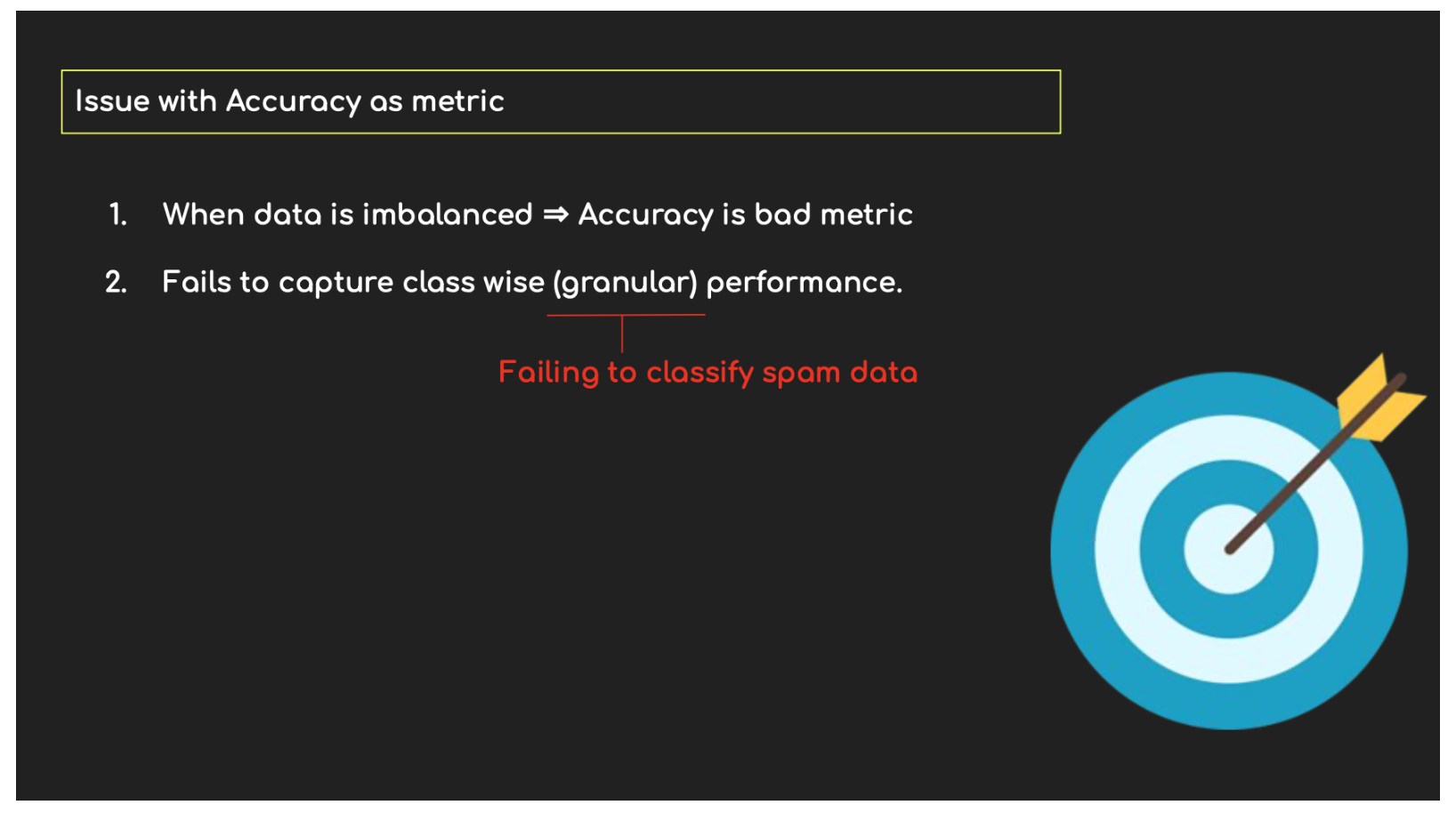
Key Insight
When data is imbalanced, accuracy alone is misleading. A model that predicts "Not Spam" for everything achieves ~70% accuracy while being completely useless!
import pandas as pd
import numpy as np
import matplotlib.pyplot as plt
from sklearn.linear_model import LogisticRegression
from sklearn.model_selection import train_test_split
from sklearn.feature_extraction.text import TfidfVectorizer
from sklearn.metrics import (accuracy_score, precision_score, recall_score,
                             f1_score, confusion_matrix, roc_auc_score,
                             roc_curve, precision_recall_curve,
                             average_precision_score, ConfusionMatrixDisplay)
3. Confusion Matrix
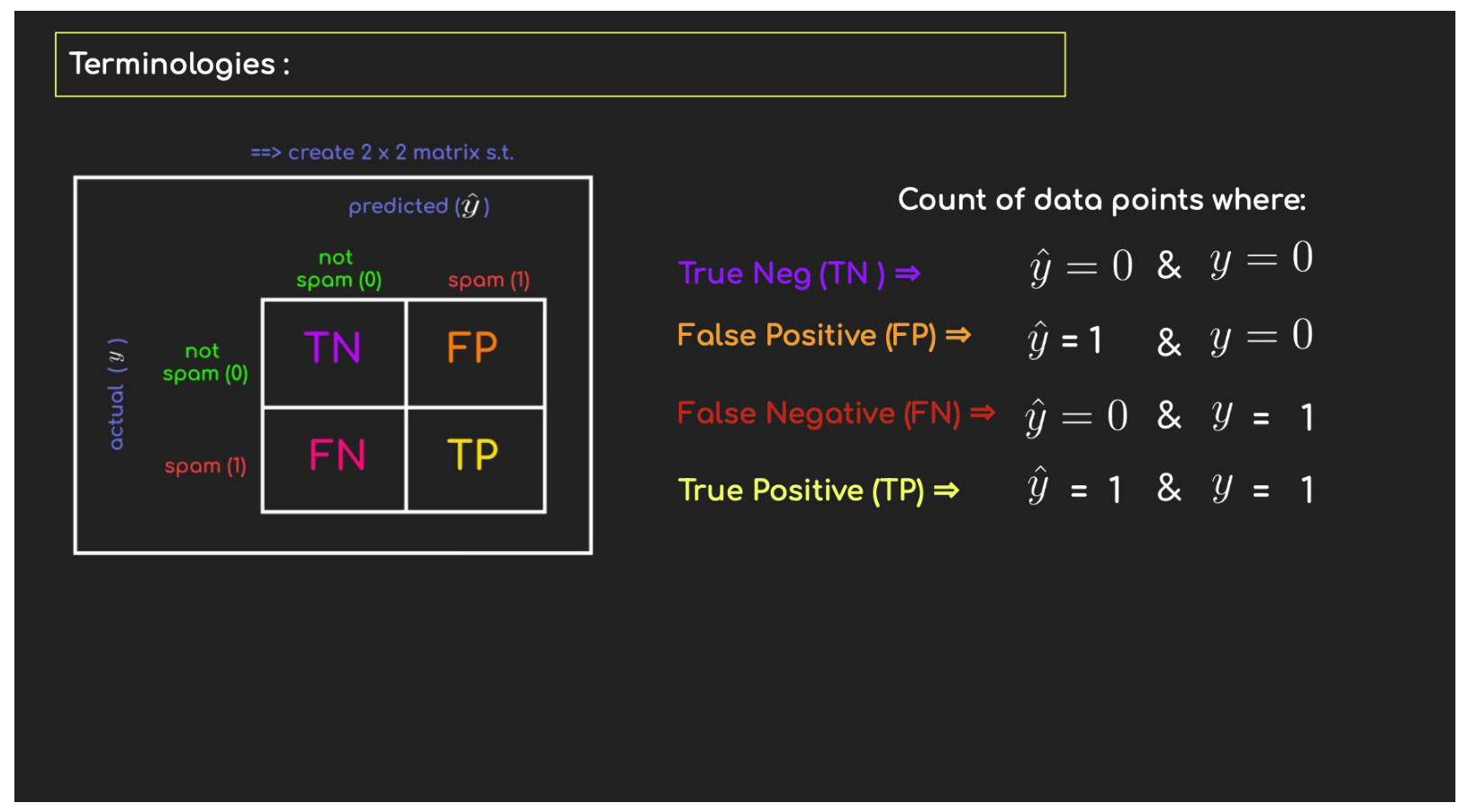
The Four Quadrants
| Predicted: Negative (0) | Predicted: Positive (1) | |
|---|---|---|
| Actual: Negative (0) | True Negative (TN) ✅ | False Positive (FP) ❌ |
| Actual: Positive (1) | False Negative (FN) ❌ | True Positive (TP) ✅ |
Definitions
- True Positive (TP): $\hat{y} = 1$, $y = 1$ — Correctly identified spam
- True Negative (TN): $\hat{y} = 0$, $y = 0$ — Correctly identified non-spam
- False Positive (FP): $\hat{y} = 1$, $y = 0$ — Wrongly marked as spam (Type I Error)
- False Negative (FN): $\hat{y} = 0$, $y = 1$ — Spam slipped through (Type II Error)
📧 Real-World Impact:
- FP: Your boss's promotion email goes to spam folder! 😬
- FN: A phishing attack reaches your inbox! 😱
# Confusion Matrix Code
from sklearn.metrics import confusion_matrix, ConfusionMatrixDisplay

# Example predictions
y_true = [0, 0, 0, 1, 1, 1, 1, 0, 1, 0]
y_pred = [0, 0, 1, 1, 1, 0, 1, 0, 1, 0]

# Create confusion matrix
cm = confusion_matrix(y_true, y_pred)
print("Confusion Matrix:")
print(cm)

# Extract values
TN, FP, FN, TP = cm.ravel()
print(f"\nTP={TP}, TN={TN}, FP={FP}, FN={FN}")
Confusion Matrix:
[[4 1]
 [1 4]]

TP=4, TN=4, FP=1, FN=1
4. Precision
Formula
$$\text{Precision} = \frac{TP}{TP + FP}$$
The Question It Answers
"When the model says 'Spam', how often is it actually spam?"
👮 Sticky Analogy: The Overeager Security Guard
A paranoid guard stops 100 people, accusing all of being intruders:
- 20 were actually intruders ✅
- 80 had valid tickets ❌
Precision = 20/100 = 20% — Only 20% of his accusations were correct!
When to Use Precision
When False Positives are costly:
- Email spam filter (don't block important emails!)
- Recommendation systems (don't annoy users with bad recommendations)
# Precision Calculation
from sklearn.metrics import precision_score

# Scratch implementation
def precision_calc(y_true, y_pred):
    cm = confusion_matrix(y_true, y_pred)
    tp = cm[1, 1]
    fp = cm[0, 1]
    return tp / (tp + fp)

# Using sklearn
precision = precision_score(y_true, y_pred)
print(f"Precision: {precision:.3f}")
print(f"Interpretation: When model says 'Spam', it's correct {precision*100:.1f}% of the time")
Precision: 0.800
Interpretation: When model says 'Spam', it's correct 80.0% of the time
5. Recall (Sensitivity)
Formula
$$\text{Recall} = \frac{TP}{TP + FN}$$
The Question It Answers
"Of all the actual spam emails, how many did we catch?"
😴 Sticky Analogy: The Lazy Security Guard
A conservative guard only stops people he's absolutely sure are intruders:
- 50 actual intruders tried to sneak in
- He only stopped 10 (all genuine intruders — great precision!)
- But 40 intruders walked right past him!
Recall = 10/50 = 20% — He only caught 20% of the intruders!
When to Use Recall
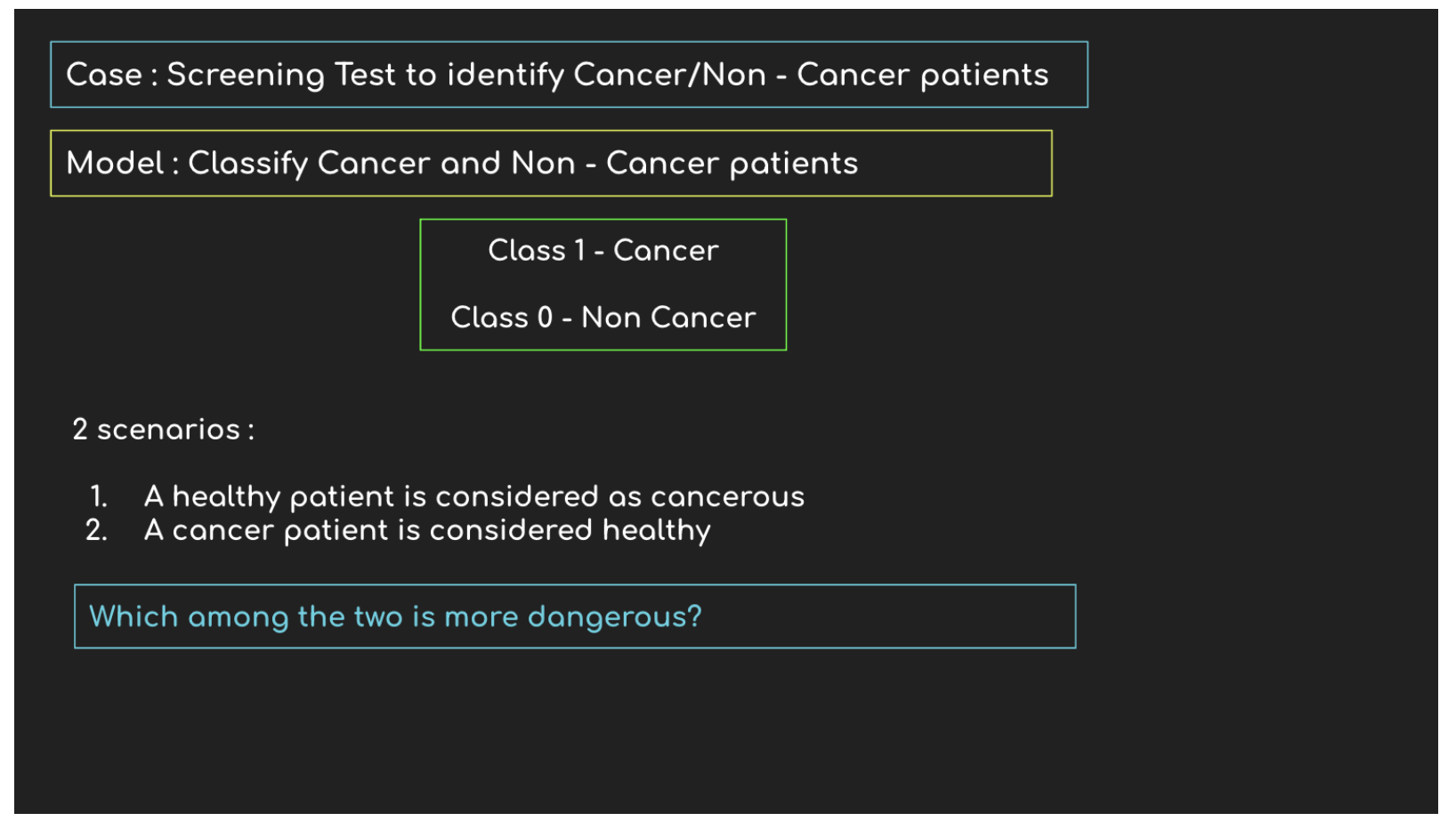
When False Negatives are costly:
- Cancer detection (don't miss a patient with cancer!)
- Fraud detection (don't let fraud slip through!)
- Airport security (don't let dangerous people board!)
# Recall Calculation
from sklearn.metrics import recall_score

# Scratch implementation
def recall_calc(y_true, y_pred):
    cm = confusion_matrix(y_true, y_pred)
    tp = cm[1, 1]
    fn = cm[1, 0]
    return tp / (tp + fn)

# Using sklearn
recall = recall_score(y_true, y_pred)
print(f"Recall: {recall:.3f}")
print(f"Interpretation: We caught {recall*100:.1f}% of all actual spam")
Recall: 0.800
Interpretation: We caught 80.0% of all actual spam
Precision vs Recall: Key Difference
| Metric | Question | Looks at... |
|---|---|---|
| Precision | "When I say Spam, am I right?" | Predicted Spam column |
| Recall | "Did I catch all the Spam?" | Actually Spam row |
6. F1 Score
The Problem: Precision-Recall Trade-off
You can game individual metrics:
- High Recall, Low Precision: Predict everything as positive
- High Precision, Low Recall: Only predict when 100% confident
Formula (Harmonic Mean)
$$F_1 = 2 \times \frac{\text{Precision} \times \text{Recall}}{\text{Precision} + \text{Recall}}$$
⚖️ Sticky Analogy: The Balanced Diet
If you eat only protein (Precision) or only carbs (Recall), you're unhealthy. F1 Score is like your nutritionist saying: "You need BOTH in balance!"
The harmonic mean punishes imbalance — having 90% precision but 10% recall gives you a low F1.
Why Harmonic Mean?
- Arithmetic mean of 90% and 10% = 50% (too generous!)
- Harmonic mean of 90% and 10% = 18% (exposes the weakness!)
# F1 Score Calculation
from sklearn.metrics import f1_score

f1 = f1_score(y_true, y_pred)
print(f"Precision: {precision:.3f}")
print(f"Recall: {recall:.3f}")
print(f"F1 Score: {f1:.3f}")
Precision: 0.800
Recall: 0.800
F1 Score: 0.800
7. F-beta Score
When F1 Isn't Enough
What if you care more about one type of error?
Formula
$$F_\beta = (1 + \beta^2) \times \frac{\text{Precision} \times \text{Recall}}{(\beta^2 \times \text{Precision}) + \text{Recall}}$$
Understanding Beta Values
| Beta | Emphasis | Example Use Case |
|---|---|---|
| β = 0.5 | Precision 2x more important | Spam filtering (don't block good emails) |
| β = 1.0 | Equal weight (F1 Score) | Balanced importance |
| β = 2.0 | Recall 2x more important | Cancer screening (don't miss any cases) |
🏥 Sticky Analogy: The Cancer Screening Dial
- β < 1: "I'd rather miss some cancer cases than cause panic with false alarms"
- β = 1: "Both errors are equally bad"
- β > 2: "I'd rather have false alarms than miss a single cancer case!"
# F-beta Score Calculation
from sklearn.metrics import fbeta_score

f05 = fbeta_score(y_true, y_pred, beta=0.5)  # Precision-focused
f1 = fbeta_score(y_true, y_pred, beta=1.0)   # Balanced
f2 = fbeta_score(y_true, y_pred, beta=2.0)   # Recall-focused

print(f"F0.5 (Precision-focused): {f05:.3f}")
print(f"F1 (Balanced): {f1:.3f}")
print(f"F2 (Recall-focused): {f2:.3f}")
F0.5 (Precision-focused): 0.800
F1 (Balanced): 0.800
F2 (Recall-focused): 0.800
8. Threshold Optimization
The Key Insight
Models output probabilities (0.7, 0.3, etc.). The default threshold is 0.5, but this isn't always optimal!
How Threshold Affects Metrics
| Threshold | Effect |
|---|---|
| Higher (e.g., 0.7) | More conservative → Higher Precision, Lower Recall |
| Lower (e.g., 0.3) | More aggressive → Higher Recall, Lower Precision |
🦁 Sticky Analogy: The Cautious Banker
"I'd rather reject 10 good customers than give a loan to 1 person who won't pay me back."
→ Lower threshold = More paranoid = Catches more defaulters = Higher recall
# Threshold Optimization Code
def find_optimal_threshold(y_true, y_scores, metric='f1'):
    """Find threshold that maximizes chosen metric"""
    thresholds = np.linspace(0.01, 0.99, 50)
    best_score, best_threshold = -1, -1

    for threshold in thresholds:
        y_pred = (np.array(y_scores) >= threshold).astype(int)

        if metric == 'f1':
            score = f1_score(y_true, y_pred)
        elif metric == 'recall':
            score = recall_score(y_true, y_pred)
        elif metric == 'precision':
            score = precision_score(y_true, y_pred)

        if score > best_score:
            best_score = score
            best_threshold = threshold

    return best_threshold, best_score

# Example
y_scores_example = [0.9, 0.2, 0.8, 0.7, 0.6, 0.4, 0.9, 0.3, 0.85, 0.1]
y_true_example = [1, 0, 1, 1, 1, 0, 1, 0, 1, 0]

threshold, score = find_optimal_threshold(y_true_example, y_scores_example, 'f1')
print(f"Optimal threshold for F1: {threshold:.2f} (F1 Score: {score:.3f})")
Optimal threshold for F1: 0.41 (F1 Score: 1.000)
9. Specificity & Related Rates
Aliases and Formulas
| Metric | Formula | Also Called | The Question |
|---|---|---|---|
| True Positive Rate (TPR) | $\frac{TP}{TP+FN}$ | Sensitivity, Recall | "Of actual positives, how many did we catch?" |
| False Positive Rate (FPR) | $\frac{FP}{FP+TN}$ | 1 - Specificity, Fall-out | "Of actual negatives, how many did we wrongly flag?" |
| Specificity | $\frac{TN}{TN+FP}$ | True Negative Rate (TNR) | "Of actual negatives, how many did we correctly identify?" |
| Precision | $\frac{TP}{TP+FP}$ | Positive Predictive Value (PPV) | "When we say 'yes', how often are we right?" |
Worked Example
100 people: 10 sick, 90 healthy
Test results:
- 8 sick correctly identified (TP)
- 2 sick missed (FN)
- 15 healthy wrongly flagged (FP)
- 75 healthy correctly identified (TN)
| Metric | Calculation | Result |
|---|---|---|
| TPR (Recall) | 8/(8+2) | 80% |
| FPR | 15/(15+75) | 16.7% |
| Specificity | 75/(75+15) | 83.3% |
| Precision | 8/(8+15) | 34.8% |
10. Top-k Accuracy
The Concept
Top-k accuracy gives credit if the correct answer appears anywhere in the top k predictions.
🎮 Sticky Analogy: The Quiz Show with Multiple Guesses
"What breed is this dog?"
- Top-1: "Labrador" ❌ (wrong)
- Top-3: "Labrador, Golden Retriever, German Shepherd" ✅ (correct answer in top 3!)
Top-1 accuracy = 0%, Top-3 accuracy = 100%
When to Use
- Multi-class problems with similar classes (dog breeds, product categories)
- Search engines and recommendation systems
- When being "close" matters
# Top-k Accuracy
from sklearn.metrics import top_k_accuracy_score

# Example: 3-class problem
y_true_multi = [0, 1, 2, 0, 1]
y_scores_multi = [
    [0.8, 0.1, 0.1],  # Class 0 predicted
    [0.4, 0.3, 0.3],  # Class 0 predicted (wrong!)
    [0.2, 0.3, 0.5],  # Class 2 predicted
    [0.6, 0.3, 0.1],  # Class 0 predicted
    [0.1, 0.8, 0.1],  # Class 1 predicted
]

top1 = top_k_accuracy_score(y_true_multi, y_scores_multi, k=1)
top2 = top_k_accuracy_score(y_true_multi, y_scores_multi, k=2)

print(f"Top-1 Accuracy: {top1:.1%}")
print(f"Top-2 Accuracy: {top2:.1%}")
Top-1 Accuracy: 80.0%
Top-2 Accuracy: 80.0%
11. Average Precision & MAP
The Problem with Precision@k
Precision@k doesn't capture ranking order!
| Engine | Results | Precision@5 |
|---|---|---|
| A | 🍕🍕🍕❌❌ | 3/5 = 60% |
| B | ❌❌🍕🍕🍕 | 3/5 = 60% |
Same score, but Engine A is clearly better — good results first!
🎣 Sticky Analogy: The Fishing Competition
You're fishing for golden fish 🐠 among regular fish 🐟.
- Precision@k: "After k catches, how many are golden?"
- AP: "Average your precision ONLY when you catch a golden fish"
- MAP: "Your average score across multiple fishing trips"
The Hand Trick 🖐️
- Precision@k = Count ALL fingers up to k → "How many have rings?"
- AP = Only look at fingers WITH rings → "Average the position of each ring"
- MAP = Do this for BOTH hands → "Average across multiple hands"
Formula
$$AP = \frac{1}{\text{Total Relevant}} \sum_{k=1}^{n} (Precision@k \times Relevance_k)$$
# Average Precision
from sklearn.metrics import average_precision_score

y_true_ap = [1, 0, 1, 0, 1, 0, 0, 0, 0, 0]
y_scores_ap = [0.9, 0.8, 0.7, 0.6, 0.5, 0.4, 0.3, 0.2, 0.1, 0.05]

ap = average_precision_score(y_true_ap, y_scores_ap)
print(f"Average Precision: {ap:.3f}")
Average Precision: 0.756
12. ROC AUC
What is ROC?
ROC (Receiver Operating Characteristic) plots TPR vs FPR at different thresholds.
The Probabilistic Interpretation ✨
"If I randomly pick ONE positive and ONE negative, what's the probability my model ranks the positive higher?"
| AUC | Meaning |
|---|---|
| 1.0 | Perfect — positive ALWAYS ranked higher |
| 0.5 | Random — 50/50 coin flip |
| 0.85 | Good — 85% chance positive ranked higher |
🎴 Sticky Analogy: The Card Sorting Game
You have 3 red cards ♥️ (positives) and 7 blue cards 💙 (negatives).
Perfect model (AUC = 1.0):
♥️ ♥️ ♥️ 💙 💙 💙 💙 💙 💙 💙All reds before all blues!
Random model (AUC = 0.5):
💙 ♥️ 💙 💙 ♥️ 💙 💙 ♥️ 💙 💙Mixed randomly.
# ROC AUC Calculation and Visualization
from sklearn.metrics import roc_auc_score, roc_curve

# Hospital example
y_true_roc = [1, 0, 1, 0, 1, 0, 0, 0, 0, 0]
y_scores_roc = [0.95, 0.85, 0.80, 0.70, 0.60, 0.50, 0.40, 0.30, 0.20, 0.10]

# Calculate AUC
auc = roc_auc_score(y_true_roc, y_scores_roc)
print(f"AUC: {auc:.2f}")

# Get curve points
fpr, tpr, thresholds = roc_curve(y_true_roc, y_scores_roc)

# Plot
plt.figure(figsize=(8, 6))
plt.plot(fpr, tpr, 'b-', linewidth=2, label=f'ROC Curve (AUC = {auc:.2f})')
plt.fill_between(fpr, tpr, alpha=0.3)
plt.plot([0, 1], [0, 1], 'k--', label='Random (AUC = 0.5)')
plt.xlabel('False Positive Rate (FPR)')
plt.ylabel('True Positive Rate (TPR)')
plt.title('ROC Curve')
plt.legend(loc='lower right')
plt.grid(True, alpha=0.3)
plt.show()
AUC: 0.86

Interpreting AUC
| AUC Range | Interpretation |
|---|---|
| 0.5 | No better than random |
| 0.7-0.8 | Acceptable discrimination |
| 0.8-0.9 | Excellent discrimination |
| > 0.9 | Outstanding discrimination |
13. PR AUC
When ROC AUC Lies
ROC AUC can be misleading with highly imbalanced data because FPR denominator (TN + FP) is dominated by the large negative class.
💎 Sticky Analogy: The Gem Inspector
Mining operation: 1000 samples, only 10 diamonds, 990 rocks.
Inspector A: Finds 8 diamonds, also flags 12 rocks as diamonds
- FPR = 12/990 = 1.2% — looks amazing!
But wait:
- Precision = 8/20 = 40% — exposes the problem!
"Precision only cares about YOUR picks — it doesn't care how big the haystack is."
When to Use
| Metric | Best For |
|---|---|
| ROC AUC | Balanced or moderately imbalanced data |
| PR AUC | Highly imbalanced data (rare events) |
# PR AUC Calculation
from sklearn.metrics import precision_recall_curve, auc

precision_vals, recall_vals, _ = precision_recall_curve(y_true_roc, y_scores_roc)
pr_auc = auc(recall_vals, precision_vals)

# print(f"ROC AUC: {auc:.2f}")
# print(f"PR AUC: {pr_auc:.2f}")

# Plot PR Curve
plt.figure(figsize=(8, 6))
plt.plot(recall_vals, precision_vals, 'g-', linewidth=2, label=f'PR Curve (AUC = {pr_auc:.2f})')
plt.fill_between(recall_vals, precision_vals, alpha=0.3, color='green')
plt.xlabel('Recall')
plt.ylabel('Precision')
plt.title('Precision-Recall Curve')
plt.legend(loc='lower left')
plt.grid(True, alpha=0.3)
plt.show()

14. Balanced Accuracy
The Problem
Regular accuracy is skewed by the majority class.
Formula
$$\text{Balanced Accuracy} = \frac{\text{TPR} + \text{TNR}}{2} = \frac{\text{Sensitivity} + \text{Specificity}}{2}$$
⚖️ Sticky Analogy: The Fair Judge
A judge evaluates performers from two cities:
- City A: 100 performers
- City B: 10 performers
Regular accuracy: City A dominates the score
Balanced accuracy: "How well did you do on City A? How well on City B? Average those!"
When to Use
- Imbalanced datasets
- When performance on both classes matters equally
# Balanced Accuracy
from sklearn.metrics import balanced_accuracy_score

# Imbalanced example
y_true_imb = [0]*90 + [1]*10
y_pred_imb = [0]*100  # Lazy model predicts all 0

acc = accuracy_score(y_true_imb, y_pred_imb)
bal_acc = balanced_accuracy_score(y_true_imb, y_pred_imb)

print(f"Regular Accuracy: {acc:.1%}")
print(f"Balanced Accuracy: {bal_acc:.1%}")
print("\nBalanced accuracy exposes the lazy model!")
Regular Accuracy: 90.0%
Balanced Accuracy: 50.0%

Balanced accuracy exposes the lazy model!
15. Cohen's Kappa
The Problem
Simple agreement percentage doesn't account for agreement by chance.
Two lazy labelers guessing "Cat" for everything = 100% agreement!
Formula
$$\kappa = \frac{\text{Observed Agreement} - \text{Expected by Chance}}{1 - \text{Expected by Chance}}$$
🎲 Sticky Analogy: The Honest Referee
Two doctors diagnosing 100 patients:
- They agree on 75 cases → 75% agreement
- But if both say "sick" 50% of the time randomly, chance agreement = 50%
Kappa = (75% - 50%) / (100% - 50%) = 0.50
"Kappa only gives points for REAL teamwork, not lucky coincidences!"
Interpretation
| Kappa | Meaning |
|---|---|
| < 0 | Worse than chance |
| 0.0 | Same as random guessing |
| 0.4-0.6 | Moderate agreement |
| 0.6-0.8 | Substantial agreement |
| 0.8-1.0 | Almost perfect agreement |
# Cohen's Kappa
from sklearn.metrics import cohen_kappa_score

rater1 = [0, 1, 1, 0, 1, 0, 1, 1, 0, 0]
rater2 = [0, 1, 0, 0, 1, 0, 1, 1, 1, 0]

kappa = cohen_kappa_score(rater1, rater2)
print(f"Cohen's Kappa: {kappa:.3f}")
Cohen's Kappa: 0.600
16. Hamming Loss
The Multi-Label Problem
What if an example can have multiple labels at once?
Example: A movie can be Action + Comedy + Sci-Fi simultaneously!
Formula
$$\text{Hamming Loss} = \frac{\text{Incorrect Labels}}{\text{Total Labels}}$$
📚 Sticky Analogy: Document Classification
A "Quantum Mechanics" paper should be labeled: Math + Physics
Regular accuracy: One wrong label = FAIL the whole prediction
Hamming Loss: "You got 3 out of 4 labels right — that's 75%!"
"The Fair Teacher gives partial credit!"
Example
| Subject | True | Predicted | Correct? |
|---|---|---|---|
| Math | ✅ | ✅ | ✓ |
| Physics | ✅ | ❌ | ✗ |
| Chemistry | ❌ | ❌ | ✓ |
| Biology | ❌ | ✅ | ✗ |
Hamming Loss = 2/4 = 0.50 (Lower is better)
# Hamming Loss
from sklearn.metrics import hamming_loss

# Multi-label example (each row = one document, each column = one label)
y_true_ml = [[1, 1, 0, 0],   # Math, Physics
             [1, 0, 1, 0],   # Math, Chemistry
             [0, 0, 0, 1]]   # Biology

y_pred_ml = [[1, 0, 0, 1],   # Math, Biology (missed Physics, added Biology)
             [1, 0, 1, 0],   # Correct!
             [0, 0, 1, 1]]   # Chemistry, Biology (added Chemistry)

loss = hamming_loss(y_true_ml, y_pred_ml)
print(f"Hamming Loss: {loss:.3f}")
print(f"Hamming Accuracy: {1-loss:.1%}")
Hamming Loss: 0.250
Hamming Accuracy: 75.0%
17. Jaccard Index
The Problem with Hamming Loss
With many possible labels, Hamming Loss gets distracted by labels you correctly DIDN'T assign.
🛒 Sticky Analogy: E-commerce Product Tags
10,000 possible tags for a handbag:
- True: {Leather, Black, Gucci}
- Predicted: {Leather, Black, Prada}
Hamming Loss: "You got 9,998 tags right!" (misleading!)
Jaccard: "Of the tags that matter, you got 2/4 = 50%" (honest!)
Formula
$$\text{Jaccard} = \frac{|True \cap Predicted|}{|True \cup Predicted|} = \frac{\text{Intersection}}{\text{Union}}$$
Key Difference
| Metric | Considers |
|---|---|
| Hamming Loss | ALL possible labels (even absent ones) |
| Jaccard | Only labels that APPEAR in true OR predicted |
# Jaccard Score
from sklearn.metrics import jaccard_score

jaccard = jaccard_score(y_true_ml, y_pred_ml, average='samples')
print(f"Jaccard Score (samples): {jaccard:.3f}")
Jaccard Score (samples): 0.611
18. Matthews Correlation Coefficient (MCC)
The Problem MCC Solves
Remember all the issues?
- Accuracy fails with imbalanced data
- Precision ignores False Negatives
- Recall ignores False Positives
- F1 ignores True Negatives
MCC uses ALL FOUR values: TP, TN, FP, FN
Formula
$$MCC = \frac{TP \times TN - FP \times FN}{\sqrt{(TP+FP)(TP+FN)(TN+FP)(TN+FN)}}$$
🎯 Sticky Analogy: The Complete Judge
Imagine hiring a judge for a talent show:
- Accuracy: "How many decisions were correct?" (fooled by imbalance)
- Precision: "When you said YES, were you right?" (ignores missed talent)
- Recall: "Did you find all the talent?" (ignores false alarms)
- MCC: "Overall, how well did your YES/NO decisions correlate with actual talent?"
MCC is the complete judge — considers everything!
Interpretation
| MCC | Meaning |
|---|---|
| +1 | Perfect prediction |
| 0 | Random guessing |
| -1 | Perfectly WRONG (flip predictions to be perfect!) |
Factory Example
1000 phones: 980 good, 20 defective
| Inspector | Strategy | Accuracy | MCC |
|---|---|---|---|
| A (Lazy) | Says "all good" | 98% | 0 |
| B (Works) | Catches 18/20 defects, 30 false alarms | 96.8% | 0.47 |
MCC exposes that Inspector B is actually doing real work!
# Matthews Correlation Coefficient
from sklearn.metrics import matthews_corrcoef

# Imbalanced factory example
y_true_factory = [0]*980 + [1]*20  # 980 good, 20 defective

# Inspector A: Lazy (predicts all good)
y_pred_lazy = [0]*1000

# Inspector B: Works hard (catches 18 defects, 30 false alarms)
y_pred_works = [0]*950 + [1]*30 + [0]*2 + [1]*18  # Simplified

mcc_lazy = matthews_corrcoef(y_true_factory, y_pred_lazy)
acc_lazy = accuracy_score(y_true_factory, y_pred_lazy)

print(f"Inspector A (Lazy):")
print(f"  Accuracy: {acc_lazy:.1%}")
print(f"  MCC: {mcc_lazy:.2f}")
print(f"\nMCC = 0 exposes the lazy model as useless!")
Inspector A (Lazy):
  Accuracy: 98.0%
  MCC: 0.00

MCC = 0 exposes the lazy model as useless!
Quick Reference
📋 Metric Selection Guide
| Scenario | Recommended Metric(s) |
|---|---|
| Balanced data, simple classification | Accuracy |
| Imbalanced data | F1, Balanced Accuracy, MCC |
| False Positives are costly | Precision, F0.5 |
| False Negatives are costly | Recall, F2 |
| Comparing models (threshold-free) | ROC AUC |
| Highly imbalanced rare events | PR AUC |
| Multi-label classification | Hamming Loss, Jaccard |
| Inter-annotator agreement | Cohen's Kappa |
| Most robust single metric | MCC |
🎯 Sticky Analogies Cheat Sheet
| Metric | Analogy |
|---|---|
| Precision | Overeager Security Guard — stops many but includes innocents |
| Recall | Lazy Security Guard — only stops who he's sure of, misses many |
| F1 | Balanced Diet — need both protein and carbs |
| F-beta | Cancer Screening Dial — tune for your priority |
| ROC AUC | Card Sorting Game — rank reds before blues |
| PR AUC | Gem Inspector — honest about rare finds |
| AP/MAP | Fishing Competition — precision at each golden fish |
| Top-k | Quiz Show — multiple guesses allowed |
| Cohen's Kappa | Honest Referee — no credit for lucky coincidences |
| Hamming Loss | Fair Teacher — partial credit for labels |
| Jaccard | E-commerce Tags — focus on what matters |
| MCC | Complete Judge — considers everything |
📊 Formula Quick Reference
| Metric | Formula |
|---|---|
| Accuracy | $\frac{TP + TN}{TP + TN + FP + FN}$ |
| Precision | $\frac{TP}{TP + FP}$ |
| Recall | $\frac{TP}{TP + FN}$ |
| F1 | $2 \times \frac{Precision \times Recall}{Precision + Recall}$ |
| Specificity | $\frac{TN}{TN + FP}$ |
| FPR | $\frac{FP}{FP + TN}$ |
| Balanced Acc | $\frac{TPR + TNR}{2}$ |
🐍 Code Import Cheat Sheet
# All sklearn imports you need
from sklearn.metrics import (
    # Basic
    accuracy_score,
    precision_score,
    recall_score,
    f1_score,
    fbeta_score,

    # Confusion Matrix
    confusion_matrix,
    ConfusionMatrixDisplay,

    # ROC & PR
    roc_auc_score,
    roc_curve,
    precision_recall_curve,
    average_precision_score,

    # Advanced
    balanced_accuracy_score,
    matthews_corrcoef,
    cohen_kappa_score,

    # Multi-label
    hamming_loss,
    jaccard_score,

    # Multi-class
    top_k_accuracy_score,
)
📌 Key Takeaways
- Never rely on accuracy alone — especially with imbalanced data
- Choose metrics based on business cost — what's worse, FP or FN?
- Use threshold-free metrics (AUC) for model comparison
- Use PR AUC for rare event detection
- MCC is the most robust single metric for binary classification
- Visualize the trade-offs — ROC and PR curves tell a story